
In many fields such as hot stamping printing, packaging decoration, and electronics industry, hot stamping foil, as a key material, directly affects the beauty and performance of the final product. As the core equipment for processing wide master coils into narrow strips of specific widths, the technical level of the hot stamping foil largely determines the subsequent use effect of hot stamping foil. This article will provide an in-depth analysis of the key technologies and challenges involved in achieving high-precision narrow strip slitting in hot stamping foil slitting machines.
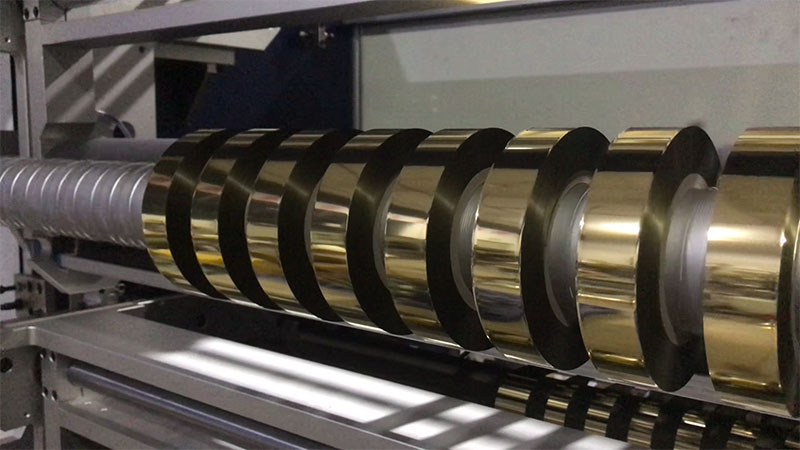
1. The core difficulties of hot stamping foil slitting
Hot stamping foil is usually composed of a multi-layer structure such as a thin PET base film, a detachment layer, a coloring layer and an adhesive layer, and the total thickness is often only a few microns to more than ten microns. This "thin as a cicada's wing" and multi-layer composite characteristics bring three core difficulties to the slitting process:
1. Extremely high precision requirements: Downstream hot stamping processes (such as fine lines, small text) require extremely high width consistency of foil strips, usually the width tolerance needs to be controlled at ±0.1mm or even narrower. Any deviation in width can result in a broken hot stamping pattern or gold overflow.
2. Material fragility: The foil film itself has low strength, easy to stretch, and easy to wrinkle. During the slitting process, excessive tension or sharp edges can cause the base film to break, the coating to peel off, or create burrs, resulting in scrap.
3. Static electricity and dust problems: High-speed friction during the slitting process is very easy to generate static electricity, which will not only absorb dust particles in the air and pollute the foil surface, but also cause potential safety hazards due to discharge in severe cases. At the same time, the tiny foil chips generated by slitting also need to be effectively controlled.
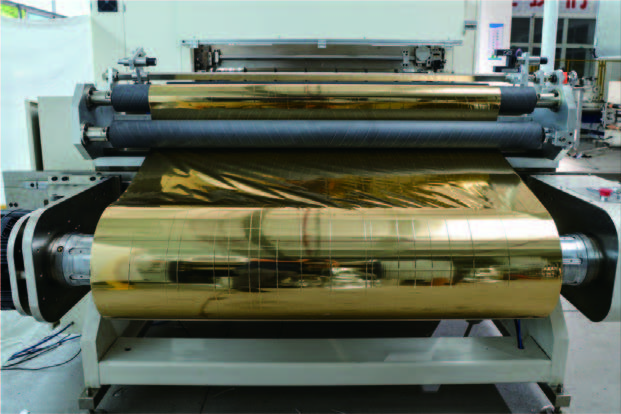
2. Analysis of key technologies for high-precision narrow strip slitting
To overcome the above difficulties, modern high-precision hot stamping foil slitting machines integrate a series of advanced technologies.
1. Precision unwinding and tension control system
Tension control is the soul of the slitting process. Due to the extremely thin substrate, tension control must be extremely precise and stable.
• Closed-loop control: High-precision sensors are used to monitor the tension during unwinding, winding and traveling in real time, and the servo motor drive system is dynamically adjusted at the millisecond level to ensure that the tension is constant at the set value and avoid stretching or relaxation caused by tension fluctuations.
• Taper tension control: As the winding diameter increases, the control system will automatically reduce the tension (taper control) to prevent winding deformation or crushing of the inner foil caused by internal tightness and external loosening.
2. High-precision slitting knife set technology
The slitting method is mainly divided into shearing and pressing, and for hot stamping foil, shearing and slitting is the mainstream.
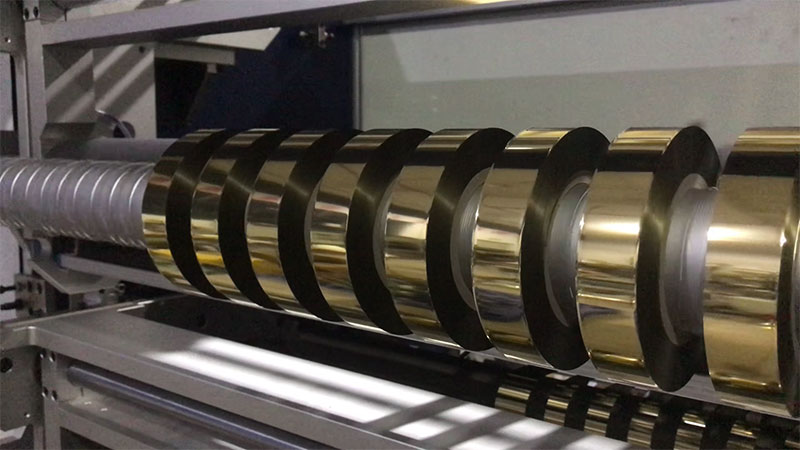
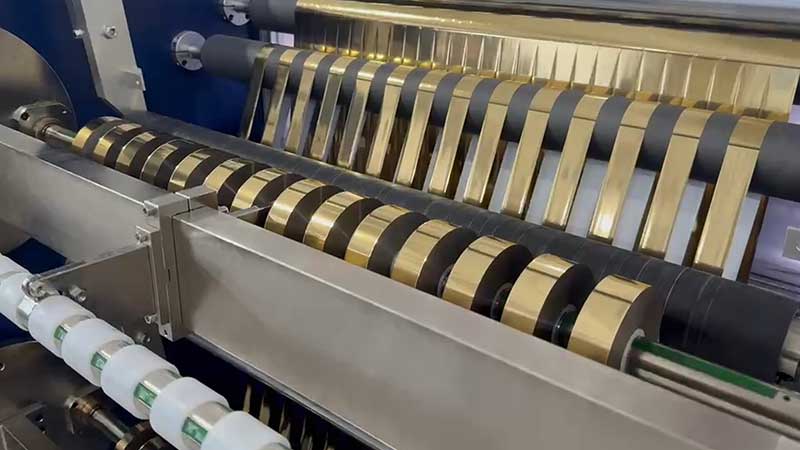
• Precise fit between upper and lower tools: Disc cutters made of cemented carbide material ensure small, precise and stable overlap between upper and lower tools in the axial and radial directions through a precise shaft system and tool holder adjustment mechanism. This "scissor-style" shearing action produces clean cuts with minimal burrs and dust.
• Blade sharpness and wear resistance: The blade edge is treated with a special grinding process to achieve extremely high sharpness, which "cuts" rather than "pulls" the foil. At the same time, the application of coating technologies (such as diamond-like coating) greatly improves the wear resistance of the blade and ensures the consistency of cut quality in long-term mass production.
• Miniaturized tool holder design: In order to achieve extremely narrow widths (e.g. strips with a width of only 2-3 mm or even narrower), the tool holder must be designed to be compact and rigid to overcome lateral forces during slitting and maintain absolute precision in the blade position.
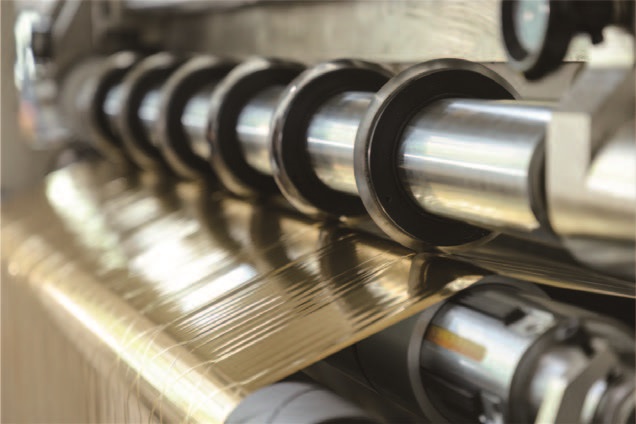
3. Low inertia guidance and flattening system
• Lightweight rollers: Lightweight and high-strength materials such as aluminum alloy or carbon fiber are used to make guide rollers, which reduce the moment of inertia of the rollers, making them respond more quickly to tension changes and reducing the impact on the foil belt.
• Anti-stick and flattening rollers: The surface of the guide roller is treated with special treatment (e.g. Teflon coating) for possible stickiness of the hot stamping foil coating. At the same time, the foil strip is fully flattened before slitting by means of a curved or spiral roller at a specific angle, eliminating wrinkles and ensuring consistency in the slitting width.
4. Static Elimination and Dust Management
• Active Static Eliminator: High-frequency and high-voltage static eliminator rods are installed in the unwinding, winding and slitting areas to effectively eliminate static electricity by generating heteropolar ions to neutralize the charge on the surface of the foil.
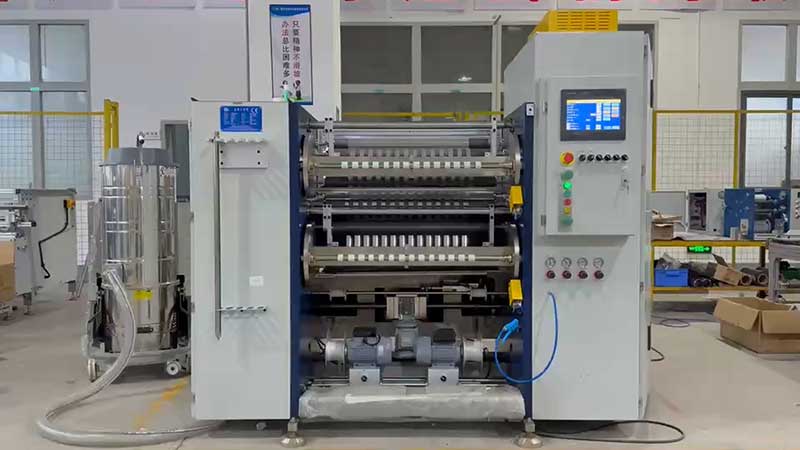
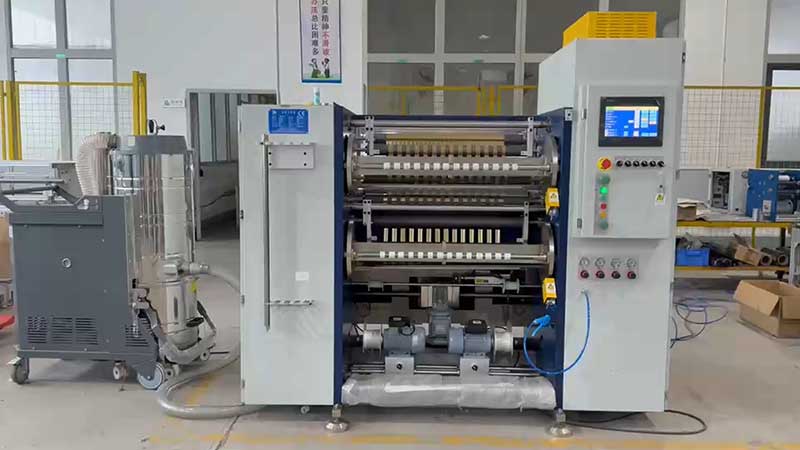
• Vacuum suction device: Equipped with an efficient vacuum suction system near the slitting knife group, the trace amount of foil shavings and dust generated at the moment of slitting is sucked away in time to avoid adsorption on the product or pollution of the working environment.
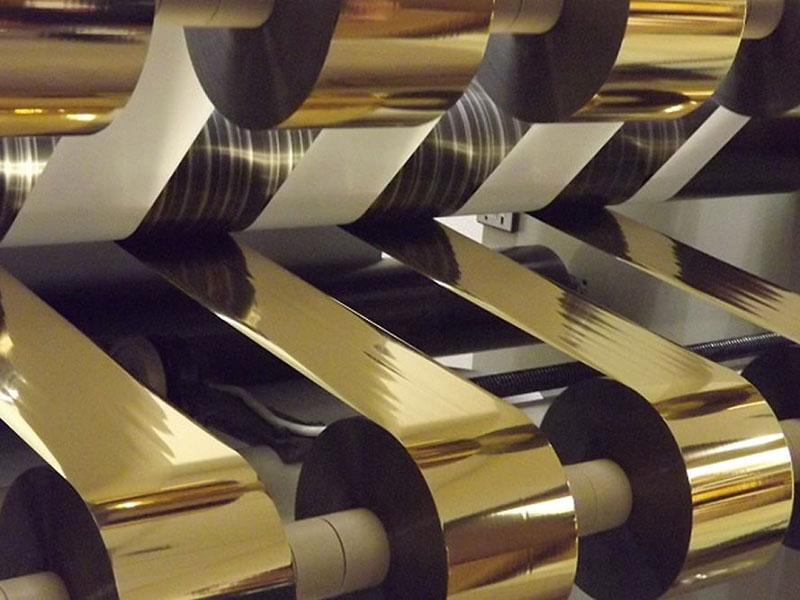
3. Trends in intelligence and automation
Modern hot stamping foil slitting machines are evolving in the direction of intelligence:
• Automatic tool setting system: The servo motor controls the lateral movement of the tool holder to realize the automatic setting and adjustment of the slitting width, greatly shortening the order change time and improving production efficiency.
• Online quality monitoring: Integrated high-resolution CCD visual inspection system to monitor the edge condition (such as burrs, notches) and width data of the foil strip after slitting in real time, and immediately alarm or automatic shutdown once an abnormality is found.
• Data management: Record and analyze key process parameters such as tension, speed, and output to provide data support for process optimization and equipment preventive maintenance.
Epilogue
The hot foil slitting machine is no longer just a simple machine that divides wide materials in half, but a complex system that integrates precision mechanical manufacturing, automated control, sensing technology and material science. It provides a reliable "grain and grass" for downstream high-end hot stamping applications by solving the problems of tension control, precision slitting and clean production of ultra-thin materials under high-speed operation. With the growth of market demand for personalized and refined hot stamping effects, high-precision, intelligent, stable and reliable hot stamping foil slitting technology will continue to play a crucial role.
 Common Problems with Hot Stamping Foil Slitting Machines and How to Solve Them
 What Specifications Should You Look for in a Hot Stamping Foil Slitting Machine?
 Hot Stamping Foil Slitting Machine Selection Guide: Tension Control Is Key
 How to choose a hot stamping foil slitting machine? Let's first look at these three parameters
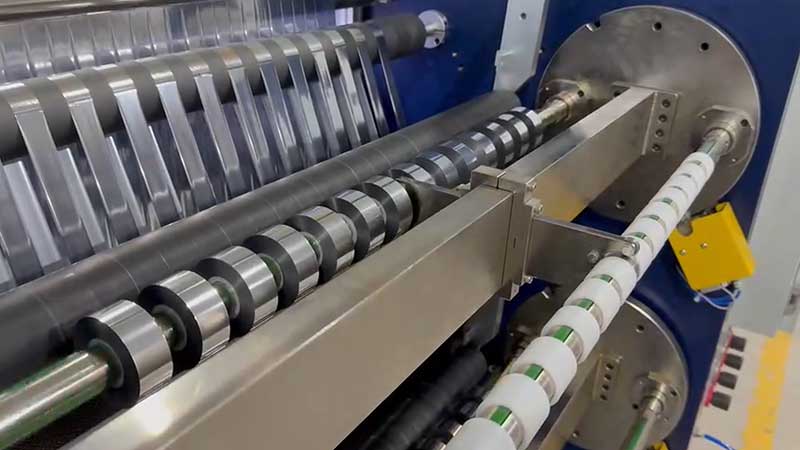 Selection of hot stamping foil slitting machines: how to match width and speed


 English
 Deutsch
 Français
 Español
 Português
 日本語
日本語 русский
 한국어
한국어 عربي
عربي ภาษาไทย
 Tiếng Việt
 Italiano
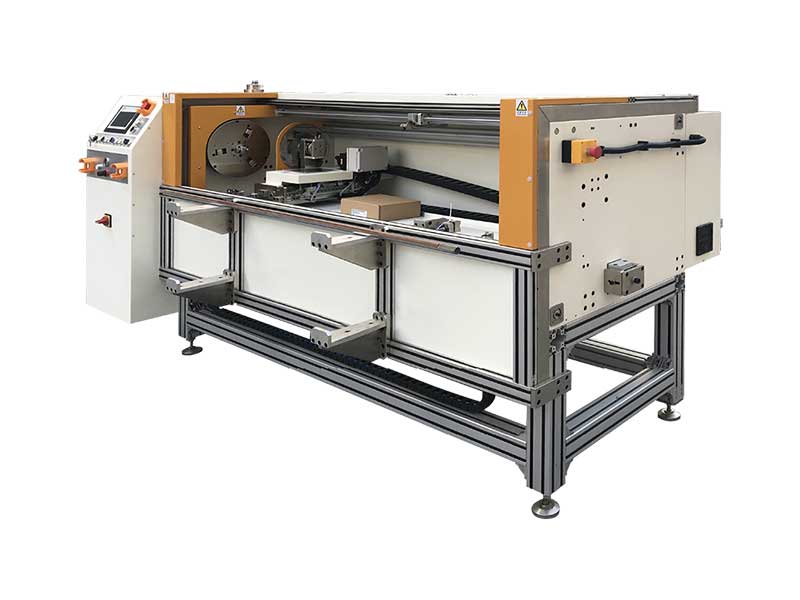 Automatic Foil Roll Cutting Machine
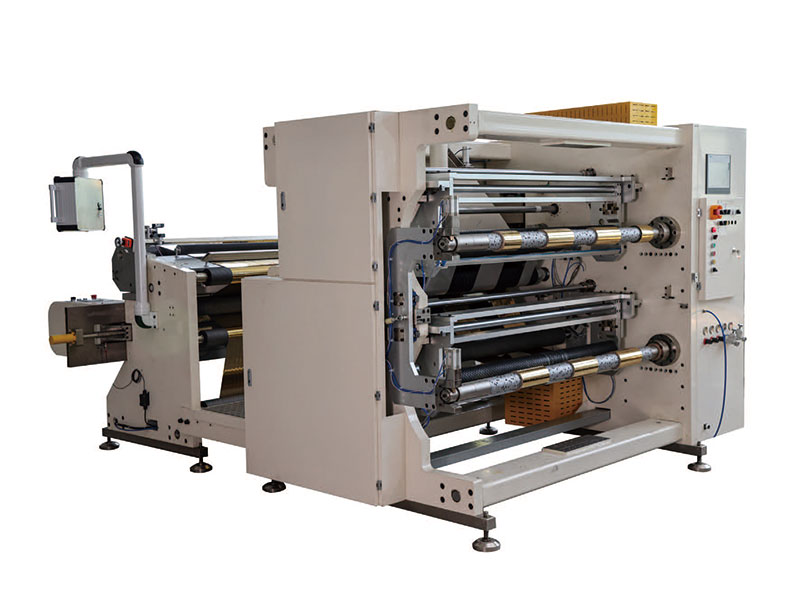 1400mm Hot Stamping Foil Slitting Machine
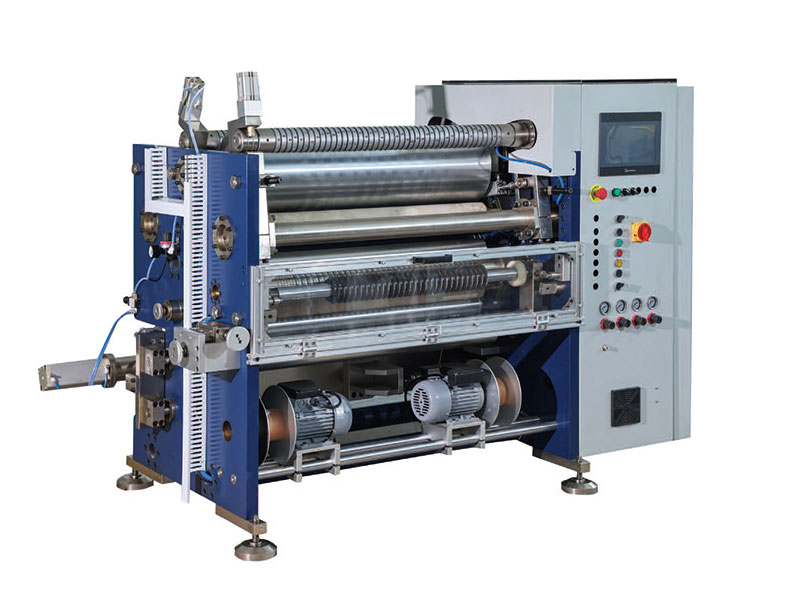 800mm Hot Stamping Foil Slitting Machine
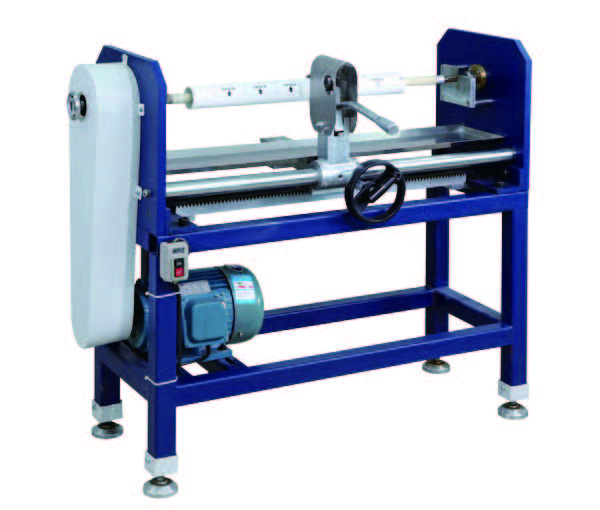 Manual Foil Roll Cutting Machine